
For many salons and beauty institutes, hair removal is a reliable revenue pillar. The choice between diode laser and IPL largely determines how efficiently you treat, which clients you can serve and how quickly your investment pays for itself. Both technologies promise long-lasting hair removal, but they work in fundamentally different ways. Those who understand the technology choose not on the basis of marketing promises but on the basis of what fits the clientele, the treatment schedule and the ambitions of the salon.
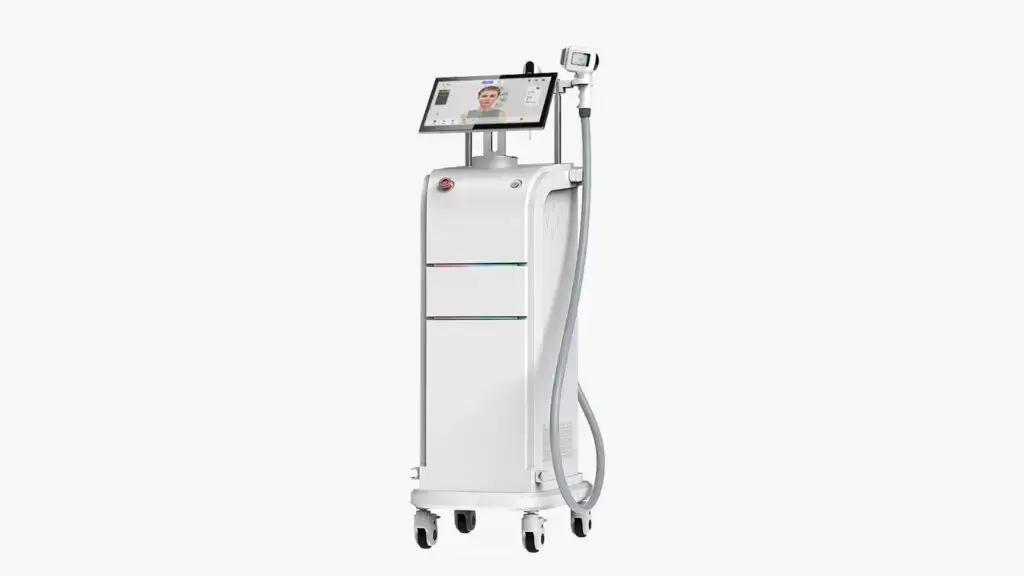
In this overview we set the two systems out side by side clearly, so that as a salon owner you can make a well-founded choice for your equipment.
How do diode laser and IPL hair removal actually work?
Both diode laser and IPL (Intense Pulsed Light) use light that is absorbed by the pigment (melanin) in the hair. That absorption converts into heat, which damages the hair follicle and inhibits hair growth. The difference lies in the nature of the light.
A diode laser emits light at one or a few specific wavelengths. This makes the energy targeted and consistent: the radiation penetrates to the depth of the follicle and focuses mainly on the hair pigment. IPL, by contrast, works with a broad spectrum of wavelengths, comparable to a powerful flash. That broad light spreads across a larger portion of the skin and is absorbed less selectively.
This difference in selectivity is the heart of the discussion around diode laser vs IPL. A targeted wavelength generally means more energy in the right place and less loss to surrounding tissue, while a broad spectrum is more versatile but works less precisely.
Skin types and hair colour: who can you treat?
For a salon, the range of clients you can serve is an important commercial factor. IPL systems generally perform best with clients who have light skin and dark hair, because the contrast between the pigment in the hair and the skin needs to be large. With darker skin, the broad spectrum can also affect melanin in the skin, which limits comfort and the safety margin.
Modern diode lasers are often more flexible on this point. Devices that combine multiple wavelengths can tailor the treatment to different skin types, including darker tones. A device such as the Lumiq diode laser hair removal device, for example, bundles wavelengths of 808nm, 755nm, 1064nm and 940nm, making skin types I through VI achievable. For a salon, that means a broader target audience and fewer clients you have to turn away.
That said, the following still holds: very light, grey or red hairs contain little melanin and respond to a limited degree with both technologies. This is not a difference between the systems, but a physical limit of light-based hair removal that you need to factor into your intake and expectation management.
Treatment time and throughput in your salon
The speed at which you complete a treatment directly determines how many clients you can see per day. IPL flashes often cover a relatively large surface per pulse, which is handy for large zones. Diode lasers generally compensate for this with high repetition rates and a gliding technique in which the practitioner moves continuously across the skin.
Power plays a role here. More powerful diode systems can deliver enough energy to work at a fluid pace without sacrificing effectiveness. When choosing equipment, it pays to look at the available power, the spot sizes of the handpieces and the cooling system, because it is precisely these elements that determine the treatment pace and comfort.
For a salon with a full schedule, a short, comfortable treatment that you can reliably repeat is often more valuable than a theoretically maximum result that requires many sessions.
Comfort, safety and cooling
Client comfort is a direct driver of reviews, repeat visits and word-of-mouth advertising. Because hair removal works with heat, skin cooling is essential. Many diode lasers feature an integrated contact cooling system that cools the skin during the pulse, which makes the treatment more pleasant and protects the skin.
The Lumiq diode laser uses a continuous compression cooling system for this, keeping the contact temperature low, which makes the difference for clients with sensitive skin. IPL systems also have cooling solutions, but the broad light spectrum produces a different heat sensation that can vary considerably from client to client.
For the practitioner, consistency is important: a predictable, comfortable treatment reduces the risk of complaints and ensures that your staff build up routine more quickly. That indirectly contributes to higher throughput and satisfied clients.
Investment, maintenance and return
Diode laser vs IPL also calls for a sober look at the business economics. IPL equipment is often lower in terms of purchase price, which lowers the threshold to start with light therapy. Diode lasers generally require a higher investment, but in return they often offer a broader client reach, a higher treatment pace and a more professional positioning.
With both technologies, pay attention to the ongoing costs. Some systems work with lamps or filters that have to be replaced or refurbished after a certain number of flashes, while other systems are designed for long-term and intensive use with minimal consumption. A professional device such as the diode laser from the UMI range is built for continuous use and comes with a multi-year warranty, which makes operation predictable.
Calculate for yourself how many treatments you expect per month, which client segment you want to serve and how long you want to depreciate the device. Only then does it become clear which system delivers the best return for your situation.
Positioning: how do you present the treatment?
The technology you choose also influences how you position your salon in the market. “Permanent hair removal with diode laser” projects a professional, clinical image for many clients, while IPL is known among a broader audience as accessible light-based hair removal. Neither is by definition better for your brand; it depends on the client segment you appeal to.
If you are working towards a premium positioning or want to distinguish yourself from salons in the area, a versatile diode laser that serves all skin types can be a strong argument. If you focus on low-threshold entry-level treatments, IPL can be a good fit. What is important is that your communication remains honest about what the treatment realistically delivers and how many sessions are needed.
Conclusion: the right choice depends on your salon
There is no universal winner in the diode laser vs IPL comparison. IPL is versatile and accessible and fits well with salons that want to start in a low-threshold way with light skin types. Diode laser offers targeted energy, a broader range of skin types and generally a higher treatment pace, which is attractive for salons that want to professionalise and expand their hair removal offering.
Let your choice be guided by your clientele, your treatment volume and the positioning you are striving for. Those who want to serve many different skin types and offer a reliable, comfortable treatment over the long term often find in a modern diode laser a future-proof foundation for the salon.
Frequently asked questions
What is the difference between a diode laser and IPL?
Both use light that is absorbed by the pigment in the hair and converted into heat, which damages the hair follicle and slows hair growth. The difference lies in the nature of the light: a diode laser emits light at one or a few specific wavelengths, making the energy targeted and consistent. IPL uses a broad spectrum of wavelengths, which is more versatile but less selective.
Which skin types can you treat with a diode laser?
Modern diode lasers are often more flexible than IPL, because devices that combine multiple wavelengths can tailor the treatment to different skin types, including darker tones. Some devices bundle wavelengths that make skin types I through VI treatable, which broadens your target audience. Keep in mind that very light, grey or red hair contains little melanin and responds poorly to any light-based hair removal.
Is a diode laser faster than IPL for your salon?
The speed of a treatment directly determines how many clients you can see per day. IPL flashes often cover a relatively large area per pulse, while diode lasers usually compensate with high repeat rates and a glide technique in which the operator moves continuously over the skin. The available power, spot sizes and cooling system ultimately determine the treatment pace, so it pays to consider these when choosing equipment.
Is a diode laser worth the investment for your salon?
IPL equipment is often lower in purchase cost, while a diode laser usually requires a higher investment but in return offers a broader client reach, a higher treatment pace and more professional positioning. With both technologies, watch the ongoing costs, because some systems use lamps or filters that must be replaced periodically. Work out how many treatments you expect per month, which client segment you want to serve and over how long you want to depreciate the device to see which system delivers the best return.